
For Mother’s Day: How to Help Your Mom Live Longer & Better!
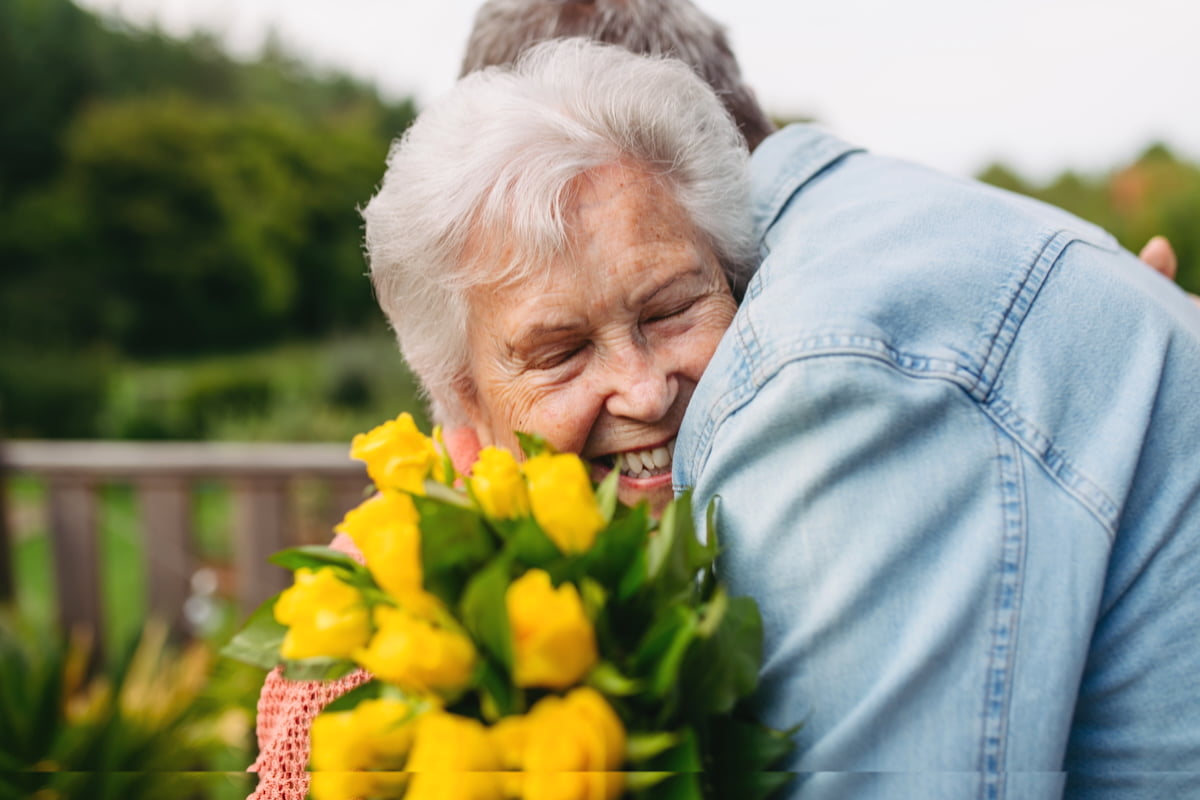
This Mother’s Day, give your mom the gift of a longer life. Not by getting her a box of all-organic dietary supplements. Or treating her to an in-home trainer. Forget about an expensive ticket on a Caribbean cruise. According to recent research, the best way to extend her life is to spend more time with her.
Time with You = Longevity
Studies find that regular time spent with loved ones can have concrete health and longevity benefits. Experts think that’s because seniors who spend frequent time with younger relatives have lower rates of loneliness. And loneliness predicts earlier mortality.
Even when you take other factors into account – like a senior’s overall physical health history and socioeconomic status – lonely people really do die sooner. Loneliness links to a 29% higher risk of heart disease and a 32% increased risk of stroke. It links to increased rates of high blood pressure, anxiety, and depression. It also predicts a 50% higher risk for dementia.
Steven Cole, PhD, Director of the Social Genomics Core Laboratory at the University of California, Los Angeles, says that loneliness links to several physical disorders. It can accelerate the buildup of plaque in a person’s arteries, help cancer cells grow, and promote inflammation in the brain which can lead to Alzheimer’s disease.
On the flip side, people who engage in meaningful, productive activities with others tend to report that they’re in a good mood most of the time. They enjoy better physical health and cognitive function. And they live longer.
Easy Cures for Loneliness
To protect against loneliness and social isolation, it is important to help your mom stay as mentally and physically healthy as possible. Encourage her to exercise often. (Walking might be perfect, especially if she has a neighborhood friend who’d like to walk with her.) Volunteering – as little as once a week – also correlates to more happiness and longer life. So maybe help her find an organization where she would enjoy donating time? And encourage her to use public transportation or a paid service like Uber to get there and back. Just the time in the car, bus, or subway will offer interaction that naturally creates social connection.
Group hobbies are good, too, the experts say. Help her join a co-op gardening group. Take a class to learn something new. Schedule time every day to stay in touch with others – by email, phone calls, or text. If a lack of tech skills keeps your mom from reaching out, help her register for a class at the local library where she can learn how to use email and other social media. She might consider adopting a pet. Studies show they link to lower blood pressure and less self-perceived stress in their human owners.
Friends Are a Must
Social support from family was once thought to be the gold standard in promoting happiness and a sense of purpose in seniors. Some new research contradicts this idea. For many seniors, relationships with relatives often feel “obligatory” while peer friendships feel “voluntary.” Researchers speculate that as we get older and increasingly dependent upon family for day-to-day help, it becomes harder to feel self-confident and capable around the relatives who help us. But friends – especially friends who are dealing with similar aging issues – can provide a sense of exchange between “equals”.
Here’s a shocking fact: when surveyed, 12 percent of seniors (that’s one in 8) had spent the previous day engaged exclusively in solitary activities. If that describes your mom (or any other senior person you care about), new social connections and activities might be the perfect Mother’s Day gift.
So this Mother’s Day, why not invite your mom over for dinner. And while you’re at it, invite someone else she might like to meet. It just might be the start of a beautiful friendship and longer life for them both!
Kate Vozoff is CEO of Amazing-Solutions, a Lamaze certified childbirth educator, and writer with special interest in all-natural health.
Sources:
- Social isolation, loneliness in older people pose health risks. https://www.nia.nih.gov/news/social-isolation-loneliness-older-people-pose-health-risks. Accessed May 1, 2026.
- Loneliness and Social Isolation – Tips for Staying Connected. https://www.nia.nih.gov/health/loneliness-and-social-isolation/loneliness-and-social-isolation-tips-staying-connected. Accessed May 1, 2026.
- Study Shows the More You Hang Out with Your Mom, the Longer She’ll Live. https://www.prevention.com/health/a20663884/elderly-friendship-prolongs-life/. Accessed May 1, 2026.
- The Benefits of Social Technology Use Among Older Adults Are Mediated by Reduced Loneliness. https://pubmed.ncbi.nlm.nih.gov/23682165/ . Accessed May 1, 2026.
- Structural Social Support and Changes in Depression During the Retirement Transition. https://www.ovid.com/journals/psss/fulltext/10.1093/geronb/gbz126~structural-social-support-and-changes-in-depression-during. Accessed May 1, 2026.
- Solitary Day, Solitary Activities, and Associations With Well-Being Among Older Adults. https://pubmed.ncbi.nlm.nih.gov/30892652/. Accessed May 1, 2026.
- Better With Age: Social Relationships Across Adulthood. https://pmc.ncbi.nlm.nih.gov/articles/PMC3291125/. Accessed May 1, 2026.
- Can group membership and volunteering predict well-being in the world values survey: Correlates, sex differences, and age moderation. https://uwindsor.scholaris.ca/items/99b490be-35da-406e-bac1-92272d8b8fb0. Accessed May 1, 2026.
- Role of Happiness in Health of Elderly. https://indianjournals.com/article/ijg-34-4-009. Accessed May 1, 2026.
